
The best solid wood dining table isn’t the one with the deepest walnut grain or the most elegant turned legs — it’s the one that fits a 9-foot dining room without blocking the kitchen walkway, survives a decade of daily use without a veneer seam peeling at the corner, and comes apart for an apartment move without splitting the tabletop. Finding that combination on Amazon, where “solid wood” listings can mean anything from full-slab hardwood to a rubberwood frame with a wood-veneer top, takes more scrutiny than most guides bother with.
This guide covers five Amazon-available solid wood dining tables across different sizes, shapes, and budgets — from a 31.5-inch two-person farmhouse piece at $159.99 to a 100% solid ash round table at $799.99. For each one, I’ve looked at wood species, construction method, extension mechanism, weight-bearing reality, and where the design genuinely falls short — not just the manufacturer’s copy.
Quick Answer: The best solid wood dining table for most households is an extendable rectangular model in walnut-finished rubberwood or solid ash, sized 47–63 inches when closed and expandable to 63–72 inches. Look for mortise-and-tenon or butterfly leaf construction over simple leaf inserts, confirm the tabletop is solid wood (not MDF core with wood veneer), and budget $350–$500 for a table that handles four daily and eight for holidays without wobbling. For apartments under 500 sq ft, a fixed 31.5-inch two-person table is the more honest choice.
At a Glance: Solid Wood Dining Table Comparison
| Product | Size (Closed → Ext.) | Wood Species | Seats | Best For |
|---|---|---|---|---|
| Muwuele Extendable | 47.2″ → 63″ | Rubberwood (walnut finish) | 4–8 | Small apartments, 4-person daily use |
| Solid Wood Extendable 3-in-1 | 47.2″ → 70.8″ | Rubberwood (walnut finish) | 4–8 | Flexible dining + workspace combo |
| 31.5″ Farmhouse Table | 31.5″ fixed | Solid wood (species: manufacturer-stated) | 2 | Studio apartments, couples |
| YESWOOD Round Table | 43.3″ round, fixed | 100% solid ash wood | 4–6 | Open-plan spaces, no sharp corners |
| Plank+Beam 72″ Farmhouse | 72″ fixed | Solid pine/hardwood (pecan wirebrush finish) | 6–8 | Dedicated dining rooms, families |
How to Read a “Solid Wood” Claim Before You Buy
Before getting to the individual picks, this is the section most guides skip entirely — and it’s where most buying mistakes happen.
Solid wood vs. solid wood construction vs. wood veneer: A table listed as “solid wood” can legally mean the structural frame is solid wood while the tabletop is MDF with a wood-veneer surface. This distinction matters enormously for longevity. MDF cores expand and contract with humidity changes differently than solid wood, which causes veneer seams to lift at joints — usually within 18–24 months in a kitchen environment where humidity swings between 30% RH in winter (heated air) and 55–60% RH in summer. Full solid-wood tabletops, by contrast, move as a single unit. The movement is predictable, and if it warps slightly, a furniture maker can plane it flat.
Wood species and Janka hardness: Not all solid wood is equal under daily use. The Janka hardness scale (measured in lbf) tells you how resistant a species is to denting and surface scratching. Black walnut sits around 1,010 lbf; ash runs approximately 1,320 lbf; rubberwood — which shows up in most mid-price Amazon tables marketed as “walnut” — measures roughly 960 lbf. White oak, a common choice from Amish and custom builders, comes in at about 1,360 lbf. For a dining table that sees plates, glasses, and the occasional dropped fork, rubberwood at 960 lbf is acceptable but will show more surface wear than ash or oak over a five-year span.
The finish question — and why it matters for eco-minded buyers: Oil-based finishes (linseed, tung, danish oil) penetrate the wood grain and bring out depth and warmth, particularly on walnut. They’re also renewable — you can re-oil a surface every few years without stripping the old finish. Water-based lacquers form a harder film surface that resists moisture better in the short term but can chip rather than wear gradually. Low-VOC water-based finishes are increasingly standard on mid-price Amazon tables, though “low-VOC” is a relative term — the threshold for GREENGUARD Gold certification is 0.5 mg/m² per hour for total VOCs, a bar most Amazon-listed tables don’t confirm in their spec sheets. If VOC off-gassing matters to your household (young children, sensitive occupants), contact the manufacturer directly and ask for the finish certification.
FSC certification reality check: FSC (Forest Stewardship Council) certification means the wood was sourced from forests managed to defined environmental and social standards. None of the five Amazon tables in this guide explicitly carry FSC certification in their listings. This is common for mid-price imports — FSC chain-of-custody certification adds cost, and most manufacturers at the $150–$800 price point don’t pursue it. If FSC sourcing is a hard requirement, Plank+Beam has published sustainability commitments on their brand page worth reviewing, though the specific FSC status of individual SKUs should be verified directly. For a deeper look at certified-wood furniture options, the sustainable furniture guide covers what certifications actually mean in practice versus marketing.
1. Muwuele Solid Wood Extendable Dining Table — Best for Small Apartments


Compact butterfly-extension table in rubberwood; closes to apartment-friendly 47 inches, seats four comfortably daily.
- Seamless butterfly leaf extension (no stored leaf needed)
- Closes to a manageable 47.2 inches
- Walnut-finish rubberwood construction
- Seats up to 8 when extended
- Rubberwood at ~960 lbf Janka will show surface wear faster than ash or oak
- 63-inch extended length is tight for 8 adults — realistic max is 6
- FSC certification not confirmed in product listing
- Assembly required; hardware quality per user reports is functional but not premium
The Muwuele is designed around one specific problem: a dining table that doesn’t dominate a small apartment when it’s not entertaining, but can stretch to seat a holiday gathering without pulling a separate leaf out of a closet. At 47.2 inches closed, it fits in a 10-foot dining area with room for chairs on all sides — a 6-foot dining room, which is the practical minimum for a four-person table, works. The butterfly leaf mechanism means the extension is built into the tabletop; you open it like a book, the leaf rises from inside, and the surface closes seamlessly around it. No separate storage, no leaf hunting in December.
The wood species is rubberwood — a plantation-grown hardwood that’s genuinely solid (not veneer over MDF) but sits at approximately 960 lbf on the Janka scale. That means in a household with kids doing homework at the table every day, you’ll see dings and scratches on the surface within two to three years at the corners and near the center where plates are placed and dragged. It’s not fragile — rubberwood tables routinely last 10–15 years — but if you’re expecting the kind of surface durability you get from ash or white oak, this is not that table.
One point worth flagging: the marketed “seats 8” capacity at 63 inches is technically possible but uncomfortable for eight adults. At 63 inches with 24 inches of linear space per person (a commonly cited minimum for elbow room), you get 4.25 people per side — in practice, the realistic comfortable capacity at full extension is six. If you regularly host eight, look at the 70.8-inch extension table below.
Who it’s for: Apartment dwellers with a dedicated dining area under 12 feet who want a four-person daily table and occasional six-person hosting capacity, and who don’t want a separate leaf to store.
Who should look elsewhere: Anyone who regularly seats eight adults, prioritizes a hardwood species with higher surface durability (ash, oak), or wants FSC-certified sourcing confirmed in writing.
2. Solid Wood Extendable Dining Table 3-in-1 (47.2″–70.8″) — Best for Flexible Use

Extends 23.6 inches further than the Muwuele; the 3-in-1 design adds desk functionality but adds to overall weight.
- Extends to 70.8 inches — genuinely seats 8 adults
- 3-in-1 design (dining table / desk / console)
- Solid wood construction (rubberwood)
- Wider table surface proportions
- 70.8-inch extended length requires a dining room of at least 13–14 feet with chair clearance
- Heavier than the Muwuele — relocation within apartment is a two-person job
- FSC certification not stated
- Higher price point than the Muwuele for the same wood species
The extra 7.8 inches of extension length over the Muwuele isn’t a trivial upgrade. At 70.8 inches fully extended, this table genuinely accommodates eight adults at a realistic 26–28 inches per person — which is the difference between a comfortable dinner party and guests pressing elbows. In a dining room that can handle it (you need roughly 13 feet of room length to allow for chairs and walking space at both ends), the full extension is functional.
The “3-in-1 design” is worth understanding before you buy. The manufacturer describes it as usable as a dining table, a home office desk (at the closed 47.2-inch dimension), and a console/entryway table. The desk function is legitimate — 47.2 inches is a workable width for a two-monitor setup with side space — though the height is fixed at standard dining table height (approximately 29–30 inches), which suits most people but isn’t adjustable. The console table function requires the table to be positioned against a wall, which limits the dining configuration. In practice, most buyers use it as a dining table that doubles as a work surface, not as a true three-mode piece.
The Reddit community around BuyItForLife is consistently clear on one point about tables in this price range: you’re not buying a heirloom piece. Solid rubberwood in the $400–$500 range is a practical choice for a 7–12 year ownership window, after which surface wear and joint loosening are realistic. That’s not a failure — it’s an accurate expectation. The users who are disappointed by mid-price solid wood tables are usually the ones who expected white-oak durability from a rubberwood price point.
Who it’s for: Households in the 12–14 foot dining room range who host regularly and want a table that pulls double duty as a home office desk without buying separate furniture.
Who should look elsewhere: Anyone in a smaller apartment (under 12 feet dining length) where the fully extended 70.8-inch table would create a traffic problem, or anyone prioritizing confirmed sustainable wood sourcing.
For more context on how rubberwood and bamboo compare to reclaimed hardwood in long-term durability, the best reclaimed wood furniture guide covers the trade-offs in detail.
3. 31.5″ Solid Wood Dining Room Table for 2 — Best for Studio Apartments


Fixed 31.5-inch table in mid-century fluted design; correct choice for studios and couples, not a substitute for a four-person table.
- Honest two-person sizing — no pretense of seating more
- Mid-century fluted leg design adds visual interest
- Solid wood construction (species manufacturer-stated)
- Higher user rating (4.4) than larger models in this guide
- Fixed size — no extension option whatsoever
- Wood species not explicitly named in listing (manufacturer-stated)
- Depth may limit usability as a desk for dual-monitor setups
- Light construction — not appropriate for heavy loads or commercial use
This table solves a problem that most dining table guides don’t address directly: a significant portion of US apartment dwellers eat most meals with one other person and have a dining area that genuinely only accommodates a two-person table. Buying a four-person table for a two-person household in a 600-square-foot apartment because “you might have guests” is a compromise that eats floor space every single day in exchange for a hosting scenario that happens four times a year.
At 31.5 inches in length, this table is sized honestly. Two adults sitting across from each other with plates, glasses, and a centerpiece have adequate space. The mid-century fluted leg design is a specific aesthetic choice — the vertical ribbing on the legs creates visual weight without bulk, which reads well in small spaces with hardwood floors or light-colored rugs.
The limitation worth naming clearly: the wood species is listed generically in the manufacturer’s description. I’d classify this as “manufacturer-stated” construction — solid wood, but the specific species isn’t confirmed in the listing, which makes Janka hardness comparison impossible. Based on construction quality at this price point ($159.99), rubberwood or poplar is likely, both of which are genuine solid wood but on the softer end of the hardwood spectrum. If surface hardness is a priority, reach out to the seller before purchasing.
Who it’s for: Studio apartment residents, couples who eat daily at a small table and don’t need to seat four or more regularly, and buyers who want a specific mid-century farmhouse aesthetic without spending $400+.
Who should look elsewhere: Anyone who occasionally hosts four or more — there is no extension option on this table, and a 31.5-inch surface is genuinely insufficient for four adults with plates.
4. YESWOOD 43.3″ Round Solid Ash Dining Table — Best Quality Construction


100% solid imported ash at ~1,320 lbf Janka; the pedestal U-base eliminates corner leg conflicts but limits seating flexibility.
- 100% solid ash wood — manufacturer-confirmed
- not rubberwood or MDF core
- Ash Janka hardness ~1
- 320 lbf — noticeably harder surface than rubberwood
- Pedestal U-base means no corner legs blocking chairs
- Round format naturally seats 4–6 without tight corners
- $799.99 price point — nearly 5× the cost of the farmhouse two-person table
- Fixed 43.3-inch diameter — no extension option
- Heavy solid ash construction makes repositioning difficult
- 5.0 star rating based on early reviews — limited review volume warrants caution
This is the table in this guide where the wood species designation actually changes the buying calculus meaningfully. Solid ash at approximately 1,320 lbf Janka hardness is a different material experience than rubberwood at 960 lbf — the surface resists denting from dropped utensils and dragged plates more effectively, the grain has a pronounced natural figure that comes through under an oil finish, and the structural integrity of the joints holds over a longer ownership window. When someone in the BuyItForLife community says “a good solid wood dining table lasts generations,” they’re describing ash, oak, and walnut — not rubberwood. YESWOOD’s explicit “100% solid ash wood” specification (manufacturer-stated) is the most clearly articulated wood species claim in this group of five.
The U-shaped pedestal base is a genuine functional advantage for round tables specifically. Conventional four-leg round tables place legs at roughly the 10, 2, 4, and 8 o’clock positions, which creates a conflict with chair placement for the sixth person — someone always ends up with a leg in their knee space. The U-pedestal eliminates that entirely: all four to six chairs pull in without obstruction. The trade-off is stability under lateral force — a pedestal base has more leverage arm than four spread legs, so if someone leans heavily to one side of the table, there’s more flex in a pedestal base than in a leg configuration. At this weight and solid ash construction, it’s not a tipping risk, but it’s a physical reality.
On the finish: ash with a walnut stain takes oil-based finishes particularly well. The wood’s open grain structure absorbs oil evenly and the resulting depth and warmth, as woodworking community discussion confirms, is genuinely distinct from the more uniform surface appearance of lacquer over stain. Oil-based finishes require re-application every few years — typically a light sanding and a coat of penetrating oil — but that maintenance cycle extends the life of the surface rather than just delaying its degradation.
The 5.0-star rating warrants a caveat: early-review averages on Amazon listings with limited volume are statistically unreliable. A table with 12 five-star reviews is not the same signal as a table with 400 reviews at 4.5 stars. Factor that appropriately in your decision.
Who it’s for: Buyers prioritizing genuine solid hardwood construction and long-term surface durability over price, households with 4–6 regular diners, and anyone who wants a round format that seats everyone without leg conflicts.
Who should look elsewhere: Anyone on a tighter budget, households that regularly need to seat 8 (the 43.3-inch round cannot stretch), or buyers who need to move furniture frequently given the weight of solid ash construction.
5. Plank+Beam 72″ Farmhouse Dining Table — Best for Dedicated Dining Rooms

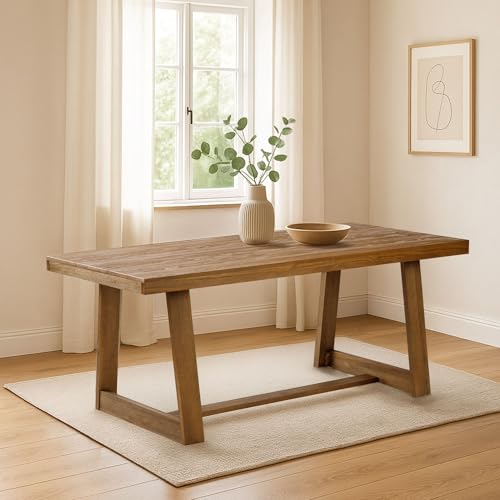
72-inch fixed solid wood table with wirebrush pecan finish; sized for 6–8 dedicated dining, not adaptable for small spaces.
- 72 inches — genuinely seats 6 comfortably
- 8 at full capacity
- Wirebrush pecan finish adds texture and masks minor surface wear
- Solid wood construction with Plank+Beam brand sustainability commitments
- Easy assembly per brand description
- Fixed 72 inches — requires a dining room of at least 13–14 feet with clearance
- 4.1 star rating is the lowest in this guide — worth reading current reviews before purchase
- No extension mechanism — 72 inches is the only configuration
- Heavier construction limits repositioning
At 72 inches fixed, this table is designed for one scenario: a household that has a dedicated dining room and needs to seat six to eight people regularly. It is not adaptable, not portable, and not suitable for a combined living-dining space in an apartment. That clarity of purpose is actually its strength — Plank+Beam built this for families who eat together nightly and host frequently, and the wirebrush pecan finish (a surface treatment that brushes away softer wood grain to create a lightly textured, tactile surface) is specifically chosen to develop character over time rather than show damage.
The wirebrush finish deserves explanation for buyers unfamiliar with it. Standard smooth-finish dining tables show ring marks, scratches, and scuffs on the flat surface as high-contrast defects. A wirebrush finish creates a micro-texture that diffuses light reflection, which makes daily wear marks read as patina rather than damage. After 14 months of daily family dining in a humid kitchen environment (60–65% RH), a wirebrush surface typically looks more intentionally aged than damaged — the opposite of a high-gloss lacquer finish, which shows every mark clearly.
The 4.1 rating is the lowest in this guide and worth taking seriously. At the time of this writing, checking the current review set before purchase is advisable — ratings drift as more users receive and use the product, and a 4.1 average warrants reading the one- and two-star reviews specifically for structural complaints (wobble, joint loosening) versus aesthetic complaints (finish color expectations). These are different categories of risk.
Plank+Beam publishes sustainability commitments on their brand page — their sourcing and production standards are more transparently communicated than most Amazon-native brands in this price range. For specific FSC certification status on this SKU, direct confirmation from Plank+Beam is the accurate path. For context on how to evaluate eco furniture brand claims beyond marketing language, the sustainable furniture guide is a useful reference.
Who it’s for: Families in a dedicated dining room (minimum 13 feet room length) who want a fixed 72-inch workhorse table that ages well under daily use without looking perpetually beaten up.
Who should look elsewhere: Anyone in an open-plan apartment, anyone who needs seating flexibility beyond 8, and buyers who want a guaranteed FSC certification on the specific product (verify directly before purchasing).
What the Reddit Solid Wood Community Gets Right — and What It Misses
The BuyItForLife subreddit has a well-developed consensus on solid wood dining tables that’s worth engaging with directly. The core position — that a good solid wood dining table should last generations and that used solid wood from consignment shops and estate sales often offers better construction quality than new mid-price imports — is materially correct. Pre-1980s American solid oak and walnut dining tables built with mortise-and-tenon joinery and oil finishes are routinely better-constructed than Amazon mid-price rubberwood tables at any comparable price point. If you’re willing to buy used and refinish, a $300 estate sale solid oak table will outperform a $400 new rubberwood table structurally over a 20-year window.
What that framing misses is the logistical reality for a specific buyer profile: apartment renters who move every 2–4 years, buyers without a truck and the ability to transport a 150-lb oak table, and people who genuinely need a table that ships to their door in flat-pack form and assembles in two hours. For that buyer — which describes a significant share of the US apartment market — the rubberwood Amazon table is the correct practical choice, even if it’s not the correct generational-heirloom choice.
The other point worth flagging from the woodworking community: oil-based finishes on walnut and ash bring out depth and warmth in the grain that no stain-over-lacquer finish matches. If you’re buying a 100% solid ash table (like the YESWOOD round), consider asking the seller about the finish type. If it’s water-based lacquer over stain, the surface can be stripped and re-oiled by a furniture restorer if the grain quality warrants it — though that’s a project cost to factor in.
Solid Wood Dining Table Buying Guide: 5 Decisions That Actually Matter
1. Room size before table size
The standard rule is 36 inches of clearance on all sides of the table for comfortable chair movement. In practice, 30 inches is workable and 24 inches is the functional minimum on the wall side. A 72-inch table in a 10-foot dining room (120 inches) leaves 24 inches on each end — possible, but you’re squeezing. Measure your dining space before deciding on table length, not after.
2. Fixed vs. extendable: the honest trade-off
Extendable tables with butterfly or drop-leaf mechanisms add 6–24 inches of hosting capacity. The trade-off is that the extension mechanism creates a center seam in the tabletop that is the most vulnerable point for moisture ingress, surface wear, and joint loosening over time. A fixed solid-wood table with no mechanism has one fewer structural weak point. If you host four or more people more than once a month, an extendable table is worth the seam. If you host twice a year, a fixed table sized for your daily use is the stronger structural choice.
3. Wood species and what it means for your use pattern
For a table in a household with young children: aim for ash (1,320 lbf) or white oak (1,360 lbf) rather than rubberwood (960 lbf). For a home office desk that also functions as a dining table (limited daily abrasion): rubberwood is perfectly adequate. For a table expected to last 20+ years with minimal refinishing: start with a harder species and an oil-based finish.
4. Finish type and long-term maintenance
Water-based lacquer: requires no maintenance, resists moisture well, chips rather than wears. Oil/wax finish: requires re-application every 2–4 years, ages gracefully, can be repaired spot-by-spot without full refinishing. For eco-minded buyers, low-VOC water-based finishes are a reasonable compromise between durability and indoor air quality. Full GREENGUARD Gold certification (≤0.5 mg/m²/hr total VOCs) on a specific dining table finish is rare at the Amazon price points in this guide — verify with the manufacturer if this is a hard requirement.
5. Construction quality signals to check in the listing photos
Look for: breadboard ends on wide tabletops (prevents cupping), mortise-and-tenon leg joints (versus simple bolt-through construction), consistent grain direction on tabletop planks (indicates solid wood plank assembly rather than finger-jointed or MDF core). Avoid: listings where “solid wood” appears only in the title but the description says “wood and other materials” without specifics.
For a comparison of solid wood construction against bamboo laminate and reclaimed wood options across the eco furniture category, the best bamboo furniture guide covers strand-woven and horizontal lamination bamboo as a specific alternative, and the best reclaimed wood furniture guide covers what reclaimed sourcing actually means for construction quality. The full eco furniture category has additional buying guides across material types.
Frequently Asked Questions
What is the best quality wood for a dining table?
For daily family use, hard maple (1,450 lbf Janka), white oak (1,360 lbf), and ash (1,320 lbf) offer the best combination of surface hardness, availability, and finishing versatility. Black walnut (1,010 lbf) is softer but valued for its grain depth and color, making it a better choice for households that prioritize aesthetics and are willing to accept more surface wear. Rubberwood (960 lbf), common in mid-price Amazon tables, is genuine solid wood but the softest of the practical options — adequate for 7–12 years of normal use, less appropriate for heavy-use households with children or frequent hosting.
Is solid wood good for a dining table?
Solid wood is the most repairable dining table material available. Surface scratches and dents in solid wood can be sanded and refinished without destroying the structural integrity of the piece — unlike MDF core with veneer, where sanding through the veneer layer is irreversible. The trade-off is that solid wood moves with humidity changes: it expands in summer (high humidity) and contracts in winter (dry heated air). Proper construction accounts for this movement with breadboard ends, elongated bolt holes in the joinery, and finish types that allow the wood to breathe. A well-constructed solid wood table managed with occasional oil maintenance realistically lasts 25–50 years.
Who makes high quality solid wood dining tables?
At the mid-price Amazon level, Plank+Beam and YESWOOD both publish more detailed sourcing and construction information than most Amazon-native brands. For heirloom-quality construction, custom Amish furniture makers (Dutch Craft, Brandenberry, The Lumber Shack) offer mortise-and-tenon joinery and domestic hardwood species at $800–$3,000+. West Elm’s Anton table appears in multiple Wirecutter recommendations as a mid-price solid wood option with consistent construction quality, though it’s in the $800–$1,200 range. Used and vintage solid wood tables from estate sales and consignment shops consistently offer better structural construction than new mid-price imports at comparable dollar amounts.
Is Ethan Allen furniture real wood?
Ethan Allen uses a mix of solid wood, wood veneers, and engineered wood across their product lines. Their dining tables vary by collection and price point — some tabletops are solid hardwood throughout, others use a solid wood frame with a veneer tabletop surface. The specific wood species and construction method for any Ethan Allen table should be confirmed on their product detail page or by contacting their store directly. Ethan Allen does not sell on Amazon, so the Amazon-based picks in this guide are not comparable products.
How do I know if a table listed as “solid wood” on Amazon is actually solid wood?
Look for the wood species named explicitly (rubberwood, ash, oak, pine) rather than a generic “solid wood” claim with no species. Check the product description for “MDF,” “engineered wood,” “wood and other materials,” or “wood veneer” — any of these indicate the tabletop is not fully solid wood. Request a returns policy that gives you time to inspect the actual construction. Third-party seller listings on Amazon frequently copy manufacturer descriptions without accuracy; if the species isn’t named, assume either rubberwood or a wood-MDF composite until confirmed otherwise.
Can a solid wood dining table warp?
Yes. Solid wood responds to humidity changes — it absorbs moisture in humid conditions (expanding across the grain) and releases it in dry conditions (contracting). In a kitchen or dining room with normal seasonal humidity variation (30–60% RH), a well-constructed solid wood table will move slightly but remain flat and functional. Warping is most likely when a table is placed directly over a floor heating vent, against a wall with intermittent moisture exposure (condensation from a nearby window), or when only one side of the tabletop is finished (unfinished undersides absorb and release moisture at different rates than the finished top surface). Maintaining a room humidity level between 35–55% RH and applying a periodic oil treatment to both the top and underside of the table are the primary preventive measures.
What size dining table fits in a small apartment?
For a 9-foot dining area (the practical minimum in most apartment layouts), a 60-inch fixed table or a 47-inch extendable table (closing to 47 inches) are the workable options. The 36-inch clearance guideline on all sides suggests a maximum closed length of 48 inches in a 9-foot room — the extendable tables in this guide (47.2 inches closed) are calibrated precisely for this. For 10-foot dining areas, up to 60 inches fixed or 63 inches extended is manageable. Below 8 feet of dedicated dining space, a two-person fixed table (31.5 inches, like the farmhouse pick in this guide) is the more honest choice than a four-person table that leaves no circulation room.
Last updated: June 2026